Increasing numbers of smaller firms in Singapore are exploring buyouts or mergers as their founders near retirement age and seek ways to put their companies on a viable footing for the future.
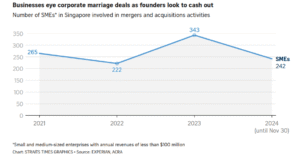
There were 343 mergers and acquisitions (M&As) involving small and mediumsized enterprises (SMEs) in 2023, up 55 per cent from the 222 in 2022.
The trend continued in 2024 with 242 corporate marriage deals as at Nov 30, noted Experian, which studied data from the Accounting and Corporate Regulatory Authority (Acra).
The data captured only those SMEs – enterprises with annual revenue under $100 million – that filed financial returns with Acra.
Mr Kenneth Leong, a partner at RPC Premier Law, said the companies looking for M&As are traditional businesses that dominated their industry in the 1970s and 1980s.
Many are original equipment manufacturers that make components for other companies’ products and have built up their businesses by riding on Singapore’s growth as a manufacturing hub.
The founders are now in their 60s or 70s, Mr Leong said, and a buyout allows them to cash out if they have no successors.
Mr Daniel Lee, senior consultant at Nihon M&A Centre Singapore, added that many of these owners started out as engineers or tradesmen, or with other humble backgrounds, building up their businesses in the process.
Their next generation may not share their aspirations, he said, adding: “Not everybody wants to take over the family business.”
Nihon M&A Centre Singapore matchmakes local SMEs with Japanese enterprises that want to venture into South-east Asia.
It has brokered more than 15 deals here since 2016, each valued at between $10 million and $50 million, for companies in the construction, information technology and distribution industries, among others.
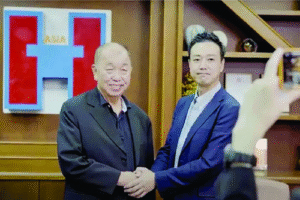
The firm sealed a deal in the construction space in 2020 that involved Japan’s Denzai Holdings taking a 71 per cent stake in local company Huationg Holdings for an undisclosed sum.
Huationg founder Lee Chin Tiong, who was 63 at the time of the transaction, had wanted to stop working for health reasons but could not find a successor. He was also concerned about his employees, whom he treated as family.
The deal allowed him to retire with the assurance that his staff would stay employed.
“Since we were both working for crane companies, they understood our business thoroughly, and I felt that their corporate culture is close to ours,” he said.
The M&A also gave Huationg the opportunity to expand into new areas as its existing business faces headwinds from the global decarbonisation trend.
Denzai has expertise in building wind power plants, Mr Lee Chin Tiong said, so Huationg can benefit from the Japanese company’s knowledge and business networks in this space.
The Covid-19 pandemic and its aftermath have played a part in the buyout trend with some “crazy years in terms of M&A activity”, said RPC’s Mr Leong.
“If I were the founder and I can see my competitors being acquired or being invested into by huge private equity funds, and hearing how much they are priced, I would be very interested to find out how much my business is priced,” he said.
He said that if there is a compelling exit option and no one is interested in taking over the reins, the founder will have a reason to sell up.
However, there is typically a valuation mismatch, given that SME founders want the best price for their business, said Mr Leong, while the potential acquirer will buy only if a company dovetails with its own operations.
He added that many founders hold on to their companies because “it is their baby”, their “blood and tears”, so buyouts in the SME space tend to take longer to seal.
Original interview article can be read HERE from The Straits Times.