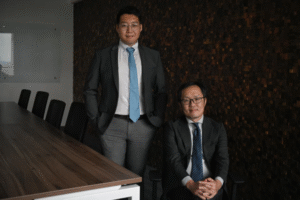
Masahiro Nishii (right), managing director of Nihon M&A Center Singapore, and Daniel Lee, senior consultant at the firm. Nihon M&A Center Singapore has closed 11 deals so far. PHOTO: MARK CHEONG
Some small and medium-sized enterprises (SMEs) in Singapore have difficulty finding successors, while some Japanese investors are looking for opportunities in South-east Asia. Nihon M&A Center Singapore aims to connect both groups.
“People here see M&A (mergers and acquisitions) more as a growth strategy for their business or partnership, not so much as a useful tool for succession planning,” said Masahiro Nishii, managing director of the boutique deal advisory firm.
In this sense, the Singapore market is “not as mature” as in Japan, where a rapidly greying society has driven more Japanese family-run businesses to seek out M&A services for succession planning, he added.
Nihon M&A Center Singapore was established in 2016 as the first overseas office of Nihon M&A Center, which is headquartered and listed in Tokyo. The latter was founded in 1991 to help the country’s ageing SME owners find successors for their businesses.
Singapore’s similarly ageing population thus presents an opportunity, said Nishii. In 2022, nearly one-fifth of Singapore citizens were aged 65 and above, up from about one-tenth in 2012. By 2030, this will grow to about one in four citizens.
On the Japanese side, Nishii hopes to fill another gap in the market: the lack of channels to connect Japanese buyers to potential targets in South-east Asia.
“I realised that there were many Japanese companies interested to invest in South-east Asia, but there weren’t many brokers focusing on the smaller SME deals,” said Nishii, who previously worked at Nihon M&A Center’s Osaka branch for over six years.
Nihon M&A Center Singapore’s clients are mostly mid-size Japanese companies with revenue of between S$100 million and S$1 billion.
On average, the centre services enquiries from more than 50 Singapore SMEs and family-run businesses each month. In most of these cases, the owner is looking to retire but is unable to find a successor, said Nishii.
The centre sees particular demand from firms in “less sexy” industries such as manufacturing, distribution, construction and information technology, said senior consultant Daniel Lee.
“Successive generations are more educated; we want to be lawyers, doctors, or join Microsoft or Google,” he added. “Not everybody wants to take over the family business.”
Nihon M&A Center Singapore has closed 11 deals so far, ranging from S$5 million to almost S$80 million. These include the sale of local heavy-lifting and specialised transportation firm Huationg to Denzai Group, one of Japan’s largest heavy haulage companies, in 2020.
all but two buyers have been Japanese companies, with the exceptions being a Singapore private equity fund and Element Materials Technology Group, a London-headquartered testing, inspection and certification company.
Element Materials was one of four buyers in 2022, acquiring Fosta Group, a soil investigation and instrumentation monitoring specialist. Element Materials itself was later sold to Singapore’s state investor Temasek in a US$7 billion deal.
Besides Singapore, Nihon M&A Center Inc has offices in Malaysia, Vietnam, Thailand and Indonesia, on top of seven branches in Japan.
Last year’s four deals represented the highest annual figure for the Singapore centre, and 2023 could bring even more. For one thing, the challenging macroeconomic environment is likely to push more SME owners to consider selling their businesses, said Nishii. “There is more uncertainty after Covid-19, which makes it timely for owners to think about their future.”
For him, the challenge is finding a consistent supply of diversified buyers to meet the growing number of firms looking to sell. This may be made harder by the yen’s depreciation, recessionary concerns and higher interest rates, which could cause valuations to dip, he said.
Read the original interview article HERE at The Business Times.