As your business grows, you may start asking yourself a big question: What’s next?
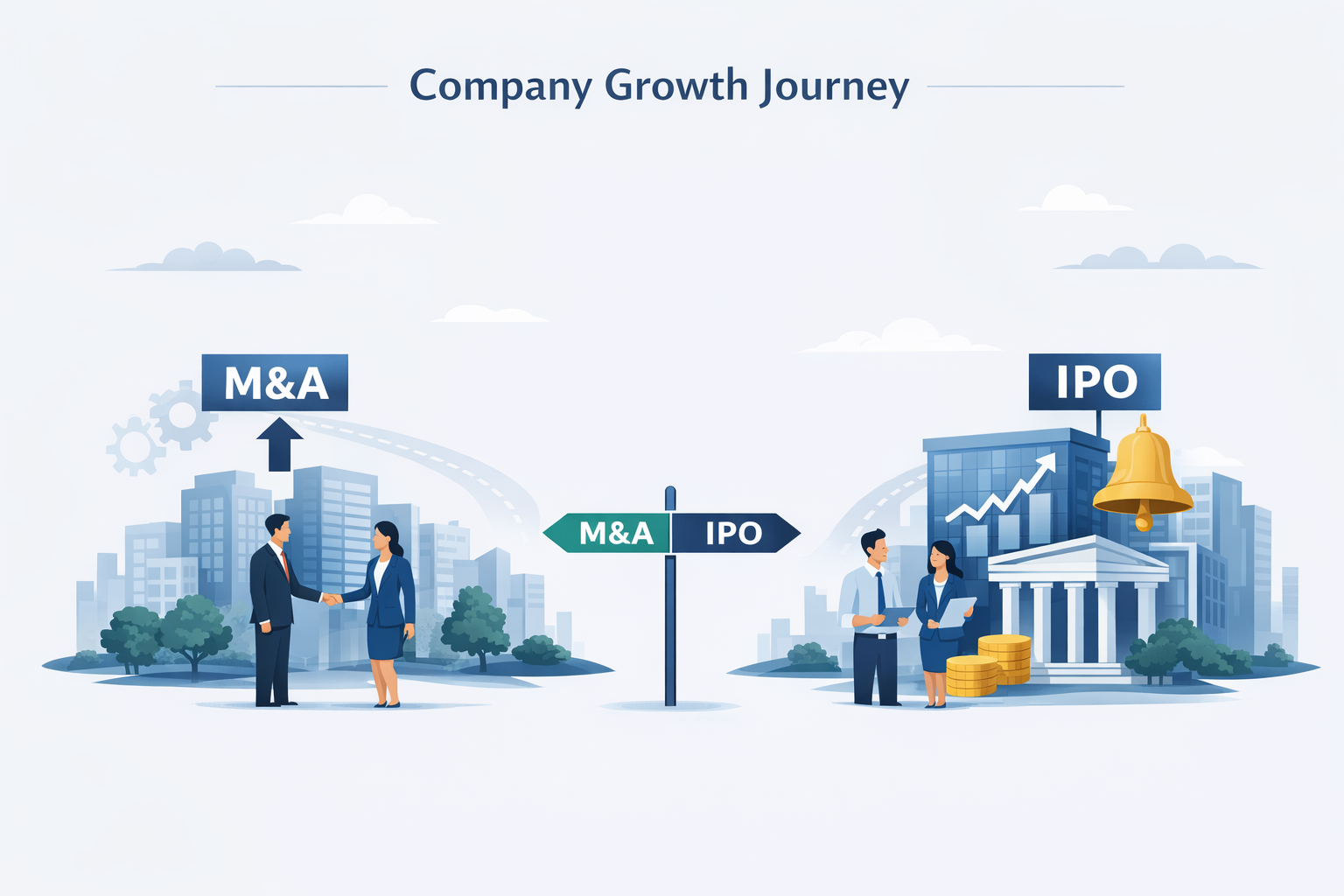
Many small and medium sized enterprises (SMEs) eventually reach a stage where they are ready to scale further, explore new markets, bring in additional resources, or even succession planning. When that happens, two common options often come up – M&A and IPO. But how do you know which route actually aligns with your long-term goals?
Both are powerful growth strategies, but they serve different purposes, advantages, and risks. Understanding how they work, and what they mean for you as a business owner, can help you make a much clearer and confident decision.
So What Do M&A and IPO Really Mean?
Mergers and acquisitions (M&A) involve two companies combining forces (a merger) or one acquiring another (an acquisition). This strategy allows business achieve strategic growth by expanding into new markets, accessing new technology, strengthening capabilities, and leveraging each other’s strength, expertise, and networks. For SMEs aiming to scale without investing years into building new structures or entering unfamiliar markets alone, M&A often presents a practical and effective option.
An initial public offering (IPO), on the other hand, is the process of listing a private company on a public stock exchange for the first time. This enables the company to raise capital from public investors, which can then be channeled into future growth initiatives. While listing brings greater visibility and credibility, it also introduces heightened regulatory oversight and the expectation of ongoing disclosure.
With these foundations in mind, let’s explore the key differences between the two options, and what they mean for SMEs considering their next stage of growth.
1. Purpose: Strategic Expansion vs. Capital Raising
Businesses pursue M&A when they want to grow strategically and efficiently. Whether the goal is to expand into a new geographic market, enhance internal capabilities, or create operational synergies, M&A allows businesses to leverage the strengths of a partner. With the right alignment, this can accelerate growth in ways that may otherwise take significant time and resources.
IPOs, meanwhile, are pursued primarily to raise capital at a substantial scale. The funds obtained can support a variety of objectives, from expanding production capacity to advancing research and development. However, going public also places the company under constant observation by investors and analysts, which can influence how management plans and executes future strategies.
2. Process: Tailored Negotiation vs. Structured Compliance
The M&A process is shaped around the needs and priorities of the parties involved. Each transaction is unique, and discussions typically involve assessing business compatibility, evaluating financials, and negotiating terms that reflect the goals of both sides. The overall process can span around 12 to 18 months, particularly when cross-border elements or complex structures are involved.
In contrast, the IPO journey follows a more standardized and regulated sequence. Companies must work closely with auditors, legal advisors, and underwriters to prepare the necessary filings, complete financial disclosures, and undergo regulatory reviews. Once these steps are completed, they move on to investor engagements and ultimately the listing itself. This structured path helps safeguard public investors but requires significant preparation and discipline from the company.
3. Ownership: Partnership Dynamics vs. Public Shareholding
One of the key considerations in M&A is how ownership and governance will change after the transaction. Some SMEs may choose to sell only a portion of their shares, allowing them to stay actively involved in the business while bringing in new investors or strategic partners. In these situations, control is shared, and major decisions may need to be aligned with the interests of the new shareholders. Others may opt for a full sale, resulting in a complete transfer of ownership.
For business owners planning succession, retirement, or seeking additional expertise to support the next phase of growth, M&A offers the flexibility to structure a deal that reflects their desired level of involvement — whether that means continuing in a leadership role or transitioning out over time.
An IPO brings in a wide base of public shareholders. While this allows the company to grow without relying solely on private capital, it also introduces new expectations around reporting, transparency, and accountability. Decisions must be made with shareholders’ interests in mind, which may change the pace and style of business management.
4. Financial Outcomes: Immediate Restructuring vs. Long-Term Equity Gains
M&A can reshape a company’s financial position fairly quickly. When two businesses combine strengths, the benefits, such as increased efficiency or expanded market reach, can lead to improved profitability over time. Although there are one-off costs like advisory and legal fees, many SMEs find that the long-term gains from a well-matched partnership outweigh the initial investment.
On the other hand, IPOs bring in a significant amount of capital upfront, which can be used to drive long-term growth. However, becoming a public company also means taking on ongoing expenses related to compliance, reporting, investor relations, and maintaining listing requirements. These are important factors business owners need to plan for beyond the listing itself.
At Nihon M&A Centre Singapore, we look at the financial impact from a long-term perspective. We help you understand how each path may affect your company’s financial health and work with you to shape strategies that enhance profitability, manage risks thoughtfully, and support your business’s future growth goals.
5. Risk Factors: Integration Complexity vs. Market Conditions
M&A brings with it the need to integrate teams, systems, and cultures – an aspect that can be challenging if not approached carefully. Successful integration always require both parties to align in values, understand how things are done, and find a synergy that works for both sides. When the values and expectations are aligned early on, the transition would naturally becomes much smoother. That is why careful partner selection and post-transaction planning are key, and having an experience advisor like us at Nihon M&A Center with cross border expertise and knowledge could help you connect with like-minded decision markers with the shared value and visions.
For IPOs, the risks are more closely tied to market dynamics. Your company’s valuation can go up or down depending on investor sentiment, economic conditions, or timing. Even after listing, how the public views the company can influence performance. This means businesses need to be prepared for these fluctuations and ensure they can maintain steady performance in the eyes of the public.
6. Long Term Direction: Strategic Repositioning vs. Public Growth
M&A can open doors to new business directions. It may enable the company to broaden its portfolio, diversify revenue, or gain capabilities that create long-term competitiveness. However, the success of this journey depends significantly on how well two organizations can move forward together after the transaction.
IPOs often mark a major milestone in a company’s evolution. With increased visibility and access to public funding, companies may find it easier to attract partners, investors, and talent. At the same time, maintaining performance that meets market expectations becomes an ongoing focus.
What Should SMEs Consider Before Choosing a Path?

When evaluating M&A and an IPO, every SME owners should reflect on these important questions:
1. What are the business and shareholder objectives?
- If succession, diversification, or accelerated expansion is the priority, M&A may be more suitable. But if your goal is to secure substantial capital while remaining in control, an IPO may be a better fit.
2. How much control am I prepared to retain?
- M&A can give you flexibility in how much of the business you want to sell, but it may also mean sharing or giving up some control depending on the deal. With an IPO, your ownership gets diluted as shares are sold to the public, and you’ll be accountable to a wider group of shareholders.
3. Am I ready for market scrutiny?
- IPOs require a high level of transparency, and once you are listed, public shareholders will expect regular updates and steady performance. If you are not ready for that kind of visibility or pressure, M&A might be a better fit. With M&A, the focus is more on working closely with your partner and aligning strategies, without the constant oversight that comes with being a public company. You can still grow and expand, but in a more private and controlled environment.
Choosing the Right Path Forward
Both M&A and IPOs can unlock meaningful opportunities for SMEs, but they shape the future of the business in very different ways. Understanding the requirements, implications, and long-term commitments of each option is essential before deciding which path to pursue.
And if you’re considering the M&A route, having the right advisor can make the process much clearer and more manageable, from understanding your options to identifying suitable partners and guiding you through each step of the transition. Nihon M&A Center Singapore is here to support you throughout this journey and help you move confidently into your next stage of growth.
Connect with us today to see how we can help support your M&A ambitions.